Circuits Math is run by an electrical engineer who grew tired of solving the same circuits from scratch. Every time a design needed its bias point checked, its gain estimated or its bandwidth confirmed, the work started again with a blank page and the same textbook equations. Circuits Math exists to cut that time: enter your component values and the analysis happens instantly, with every step shown.
Circuit calculators
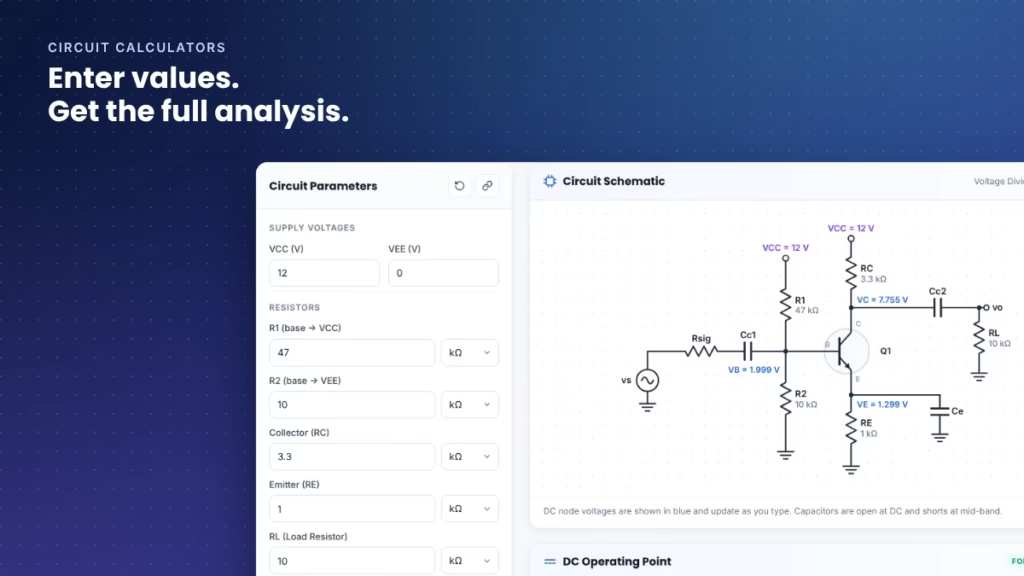
The Circuit Calculators analyze circuits as you type. The first set covers 22 BJT and MOSFET amplifier configurations: NPN and PNP transistors in common-emitter, common-base and common-collector form, and NMOS and PMOS transistors in common-source, common-gate and common-drain form. More calculators, including electric circuit analysis, are on the way.

Tutorials and projects
Alongside the calculators you will find tutorials and project guides on Arduino programming, embedded systems and communication, digital systems and MATLAB. They are written to explain the reasoning behind a design, not just the final answer, for students and practicing engineers alike.
How the calculators work
Each calculator follows the method an engineer uses by hand: solve the DC operating point first, check that the transistor is in the right operating region, then use the small-signal model to find gain, impedance and frequency response. Because every result shows the equation and the numbers substituted into it, you can check the working, learn from it, or reuse it in your own notes.

Accuracy and feedback
The calculators use standard first-order models, so they are a fast and reliable starting point for study and design. Real components vary, so confirm critical designs with datasheets, simulation and measurement. If you spot an error or would like a calculator for another circuit, please get in touch through the contact page.